Supporting stable operations and improved productivity of customer equipment by realizing efficient maintenance management
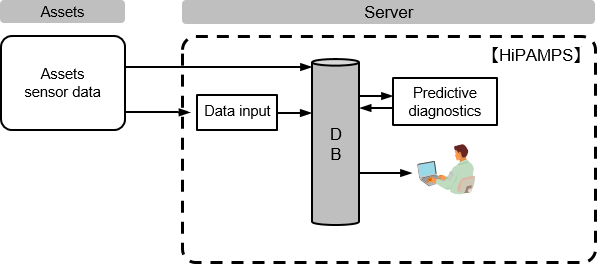
HiPAMPS analyzes sensor data collected from equipment and detects unusual statuses.
A high operation rate is required for machines and equipment, and if such machines and equipment stop unexpectedly, extensive damages will result for manufacturers and related companies. However, there is a lot of equipment that cannot aid unexpected stoppage, in which data collected for the monitoring status of machines and equipment cannot be effectively used or automatic status monitoring is unavailable due to limited costs.
HiPAMPS effectively uses sensor data collected from machines and equipment through data mining technology and immediately notifies the user of any variation in the machines and equipment status.
With this system, we support the implementation of Condition Based Maintenance (CBM) for appropriate maintenance performed in accordance with the equipment status, and contribute to the prevention of unexpected stoppage and the reduction of maintenance costs.
In order to satisfy customer needs such as “How long can we use the equipment?” and “We would like to know the risk of failure occurrence,” we will contribute to the improvement of the customer equipment operation rate, maintenance schemes and further reduction of management costs.
HiPAMPS is capable of diagnosing status variations with the data mining function that utilizes statistical data classification as well as the threshold determination function (optional) that utilizes experiences and knowledge as the detection conditions.
<Patent No. : JP 4832609>
The diagnosis engine suitable for your equipment and needs can be selected from the following.
*: These technologies have been developed by Hitachi, Ltd.
The system can be configured by a minimum of one personal computer. It can also be enhanced according to the required functions and performances.
The diagnosis results and machine/equipment status are displayed on the screen in different colors. With this interface, the equipment status can be grasped visually. In addition, the stepwise screen shifting suppresses unnecessary user operation during analysis.
<Patent No. : JP 5081999>
The threshold determination function for detecting status variation levels and status variation rates in accordance with input conditions designed by engineers can be used concurrently. This function can grasp if a status variation suddenly occurs in any equipment. In addition, equipment statuses can be explained easily, facilitating the determination of the next action to be taken.
HiPAMPS achieves more accurate predictive diagnosis using the database of maintenance information built when learned data are selected.
Based on the records of past failures and maintenance operations and the related sensor information registered to HiPAMPS, information about past similar incidents is displayed if any failure is predicted. This function allows less time to be spent on estimating the cause of a failure.