Uoroku Co., Ltd.
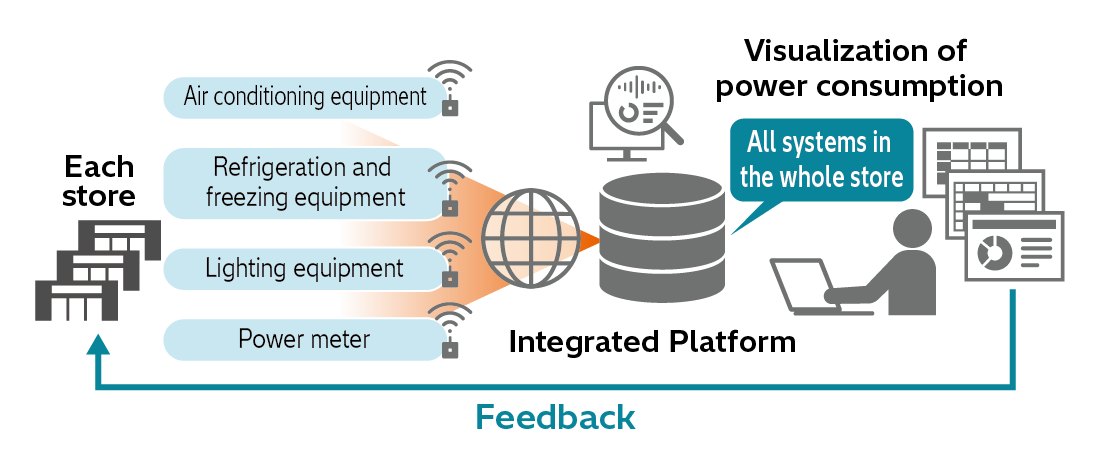
For this project, we built and operated the two core functions of the Energy & Facilities Integrated Platform (referred to below as the “Integrated Platform”) in two phases. We launched the project under “One Hitachi,” bringing in members from both Hitachi, Ltd. and Hitachi Systems, Ltd. and began defining the requirements. The themes of STEP 1 are to centrally manage energy data for each major piece of equipment in a store, and to analyze and visualize that data from an energy-saving perspective. We have reduced the need for spreadsheet-based management and individual handling of equipment that was performed until now, and have enabled the Integrated Platform to handle many of the related tasks.
We completed the system development in about six months after launch, and began offering STEP 1 services at all stores in February 2025.
“The data we obtained from the Integrated Platform was very interesting, and it gave us a lot of insights. For example, it has become clear that energy-saving products, such as lighting with a dimming function, can help reduce electricity consumption, and that a store’s design and location can significantly affect its air conditioning energy usage. Analyzing this data enables us to standardize the operation of electrical equipment. We are currently preparing a manual so that store staff can easily save energy and reduce costs by following its rules.”
With the implementation of energy management services and the rollout of improvement measures, the goal for Step 1 is to reduce the total electricity costs across all Uoroku stores by 3 to 5 percent. In fiscal year 2026, when the company enters the effectiveness-measurement phase, it plans to add a weekly report generation app that will provide energy information to each store, and aims to show results by accelerating the PDCA cycle.
“Based on the results of Step 1, we plan to move forward with the implementation of Step 2. What we want to achieve in that step is predictive maintenance. Our current equipment management is based on reactive maintenance, which involves repairing or replacing equipment only after it breaks down. For example, if refrigeration or freezing equipment suddenly breaks down, it can result in the disposal of products or lost sales opportunities, and the resulting financial losses can be substantial. We want to implement thorough facility management and maintenance practices, and shift to a system where we fix things before they break. In addition, it enables planning for the replacement of equipment and machinery, and managing budgets. If we can achieve all of this without needing human intervention, it will be a revolution in supermarket facility management.”
Mr. Gawasawa says he would like to widely publicize this case study to supermarket industry groups and others.
“We want to use our company’s experience to help solve challenges facing the entire industry. The issues facing the supermarket industry, including the shortage of workers, are all challenging, and not easy for individual companies to solve. Therefore, we hope to share our single company’s success story with the industry, to help address these common challenges. That will allow store staff to focus on the core aspects of retail service. My dream is to create that kind of virtuous cycle and harness it to drive the industry’s growth.”
Mr. Gawasawa also has yet another grand vision.
“It is generally said that 50 percent of a supermarket’s electricity consumption is by refrigeration and freezing equipment, 20 percent is by lighting, 20 percent is by air conditioning, and 10 percent is by elevators, kitchens, and the rest. However, if we look at the accumulated data, we see that the actual percentages vary significantly between stores. That raised numerous questions, such as, “What is the appropriate size of refrigeration and freezing equipment for a given store size?” and “How does the air conditioning’s set temperature vary with site-location conditions, such as sunlight and air temperature?” I believe that by identifying the optimal conditions for a store’s location, design, and facilities, we can achieve an ideal store design that maximizes energy efficiency and minimizes management costs.
That’s another reason why I want to create an environment where I can focus more on my main job. I want the Hitachi Group to provide outstanding AI services that can support me in performing my tasks or do them for me.”
Mr. Gawasawa views his company’s challenges as common issues shared by the entire industry. His perspective aligns with Hitachi Power Solutions’ approach to proposing solutions, which includes viewing our customers’ challenges as challenges for the industry as a whole, and working together to develop solutions.
Hitachi Power Solutions will continue to fully support Uoroku’s efforts.
Uoroku Co., Ltd.